Why AI Coaching Needs Knowledge, Memory and Visible Uncertainty
Fluent answers are easy to mistake for informed answers.
An AI coach can write a convincing paragraph with almost no athlete context. That is precisely why the product architecture matters more than the tone of the response.
A useful coaching system needs four separate capabilities: specialist knowledge, an athlete record, individual memory and deterministic calculation.
It also needs the confidence to say what it does not know.
Knowledge and memory are not the same thing
Flow Momentum separates three knowledge layers.
1. Shared specialist knowledge
The Performance, Nutrition, Communications and Team experiences are built around maintained specialist knowledge bases and research-backed sources.
This is general domain knowledge. It can explain training principles, fuelling considerations, communication structures or team routines. It should not contain unverified claims about one athlete.
2. The athlete record
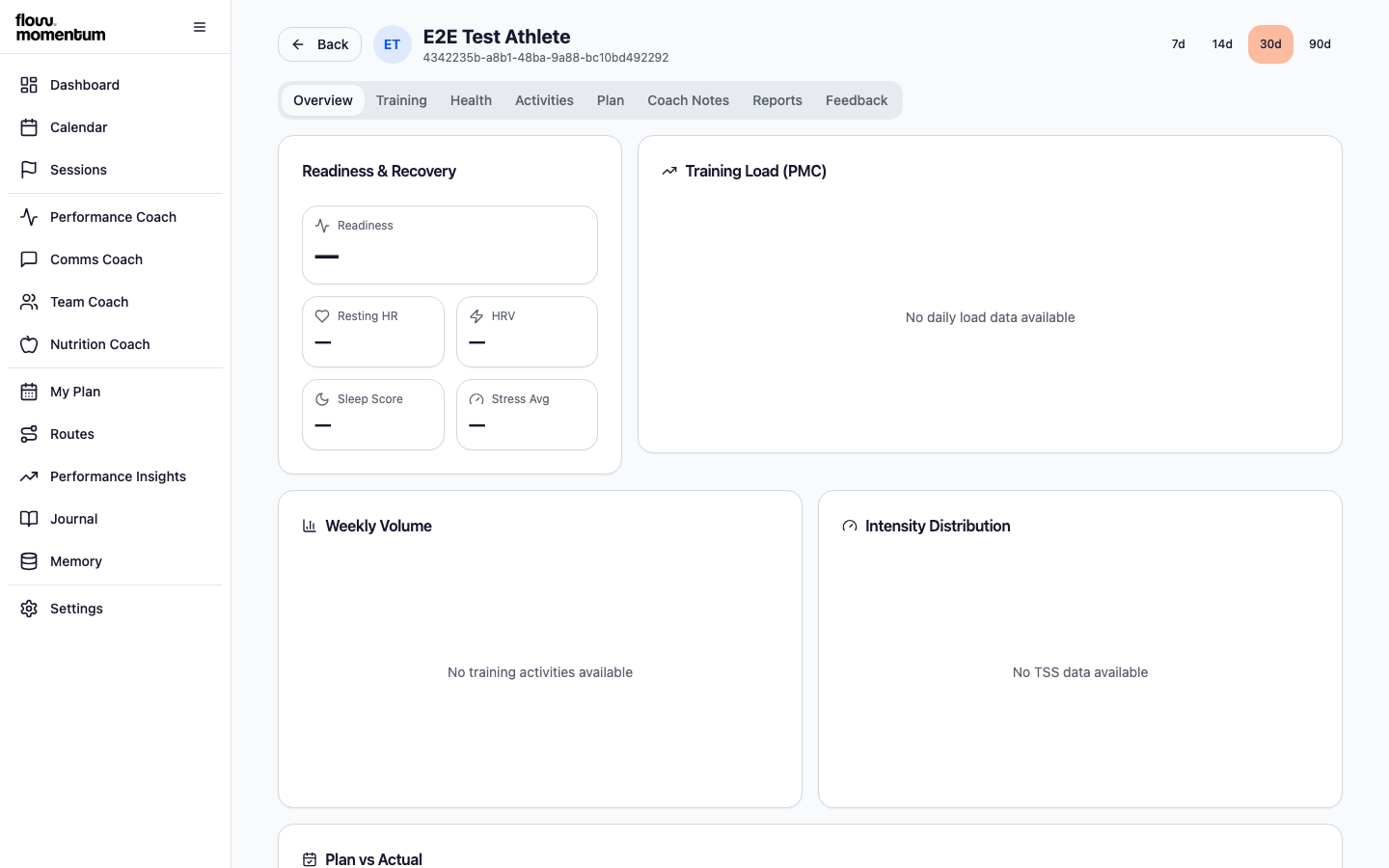
The athlete record contains supported training, recovery, profile and plan data. It is the longitudinal evidence for one person.
A power value, sleep score or uploaded session belongs here, with its source and availability intact.
3. Confirmed athlete memory
Memory captures context that may remain useful across future decisions: goals, preferences, constraints, responses to training and agreed coaching learnings.
This layer should be athlete-specific, reviewable and correctable. It should not silently convert every message into permanent fact.
The distinction sounds technical. In practice, it prevents a common failure: treating a general training principle as a personal prescription, or treating a casual comment as an enduring athlete preference.
Why long-term memory is difficult
Research on conversational memory tests more than simple recall.
The LongMemEval benchmark includes information extraction, reasoning across sessions, temporal reasoning, knowledge updates and abstention. The last capability matters. A system should know when a relevant memory is absent rather than producing a plausible substitute.
Current public discussion about AI memory often focuses on benchmark scores. The more practical product question is governance: what is allowed to become memory, how is it corrected and who may retrieve it?
Flow Momentum's answer is confirmation and athlete scope. The system can build a living coaching wiki, but the context stays connected to the relevant athlete and permission boundary.
Calculation should not be delegated to prose
Language models are useful for synthesis and explanation. They are not the right place to hide repeatable calculations.
Training load, intensity distribution, ramp rate, threshold estimates and readiness components should be calculated by explicit services from available inputs. The language model can then explain the result, identify relevant specialist knowledge and ask what evidence is missing.
This creates a clearer decision trail:
| Layer | Role |
|---|---|
| Source record | Stores what was measured or uploaded |
| Calculation service | Produces repeatable indicators |
| Specialist knowledge | Provides relevant domain principles |
| Athlete memory | Adds confirmed personal context |
| AI interpretation | Explains, compares and proposes questions or actions |
| Human judgement | Accepts, changes or rejects the recommendation |
The layers can work together without becoming indistinguishable.
Why visible uncertainty improves decisions
The NIST AI Risk Management Framework recommends documenting knowledge limits, intended use and human oversight. It also notes that removing context from complex human phenomena can make impacts harder to understand.
For coaching, uncertainty may come from missing heart-rate data, stale thresholds, incomplete training history, low-quality sensor coverage or absent athlete feedback.
The product should surface those limits. A lower-confidence recommendation with clear reasons is more useful than a confident recommendation built on assumptions.
This is particularly important for a human coach. The Coach Assistant should operate as a sparring partner that helps investigate the selected athlete, not as an invisible authority.
What individual learning should improve
Confirmed memory can make future questions more efficient.
The system may remember that an athlete:
- has a specific target event;
- cannot train on particular mornings;
- responds poorly to late high-intensity work;
- prefers concise race-week instructions;
- has agreed a particular threshold or fuelling approach with the coach.
That continuity can improve recommendations without changing the global knowledge base.
It also creates a responsibility: outdated context must be correctable. A preference is not a permanent identity.
Ask Flow Momentum
Try:
"Use my confirmed goals and constraints, but separate them from measured training data. Show the calculation behind your recommendation, identify the relevant specialist principle and list anything that could change the decision."
That prompt asks for more than an answer. It asks for a transparent reasoning structure.
Try this week
Open an AI answer you used for a real decision.
Mark each sentence as source evidence, calculation, remembered context, general knowledge or interpretation.
If you cannot tell which is which, the system has given you prose rather than decision support.
Frequently asked questions
Closing thought
The best AI coaching experience will not be the one that remembers everything. It will be the one that remembers the right things, shows its limits and leaves judgement in responsible hands.
Sources
- NIST AI Risk Management Framework
- NIST AI RMF Appendix C: Human-AI Interaction
- LongMemEval: Benchmarking Chat Assistants on Long-Term Interactive Memory
- Learning What to Remember: a multi-factor model for agentic memory
- Public discussion: memory layers and deterministic tools in AI systems
- Flow Momentum: how the product separates data and AI
Get the next Note
Practical ideas on performance, recovery, AI and better work — straight to your inbox.