Why Endurance Coaches Need an Athlete Workspace, Not Another Dashboard
An endurance coach rarely lacks data.
The harder problem is moving from data to a responsible coaching action across several athletes without losing context.
One athlete sends a FIT file. Another connects a device. A third reports that an easy session felt unusually hard. The coach needs to inspect the evidence, understand what changed, record the judgement and communicate the next step.
A static dashboard handles only one part of that work.
What does an endurance coach workspace need to do?
A useful workspace should support the full coaching loop:
- Create or invite an athlete.
- Receive authorised training data.
- Review sport-specific trends and individual sessions.
- Compare planned and completed work.
- Add private notes or confirmed athlete context.
- Prepare a report for the athlete.
- Return to the same evidence when the next decision arrives.
Flow Momentum's Coach Workspace is being built around that sequence.
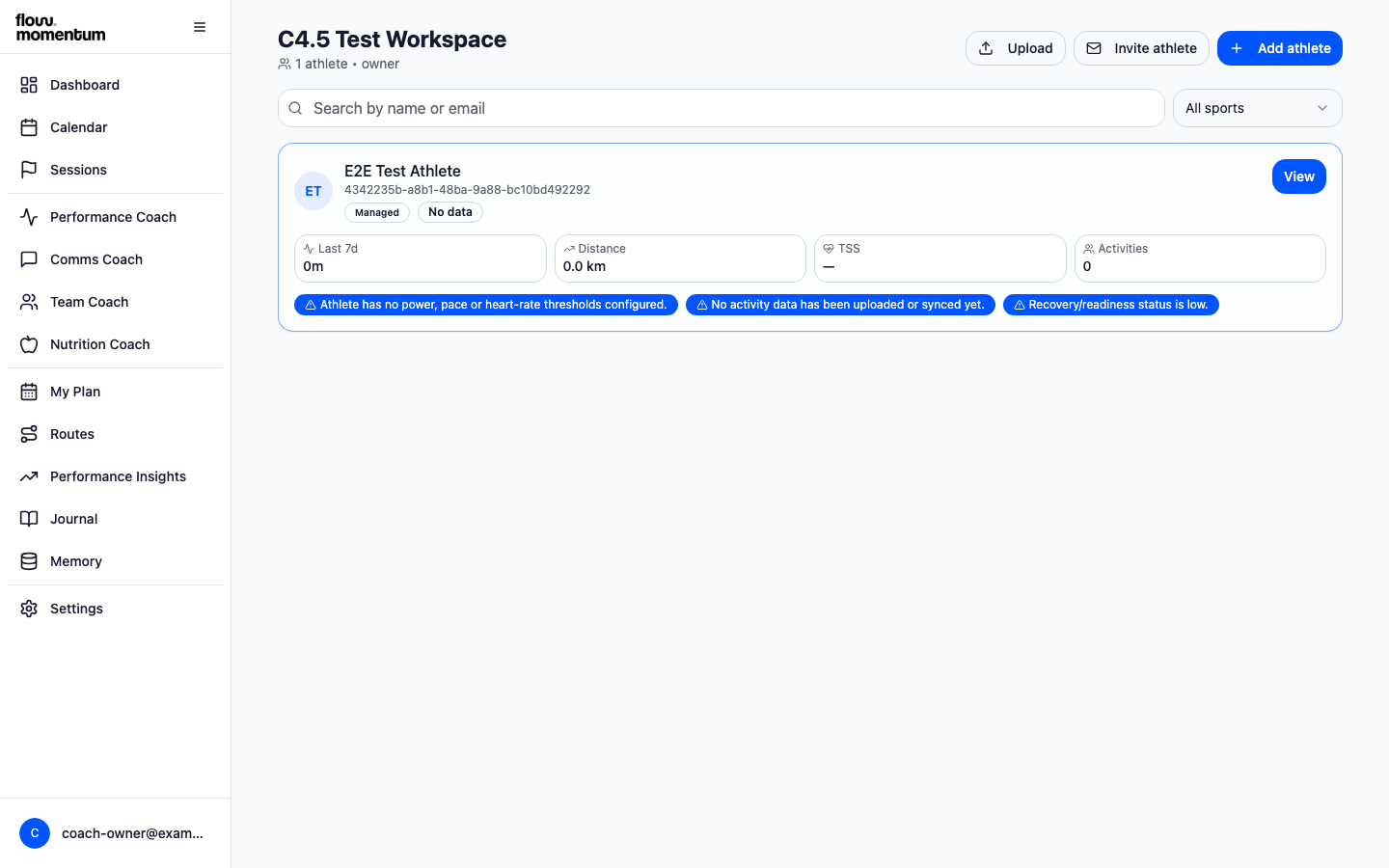
The coach can manage a roster of athletes, upload supported files, open one athlete cockpit, review the available analysis, keep notes and prepare structured reports. A managed athlete can later claim the same record rather than starting again.
Why the athlete and coach can read the same session differently
Monitoring is not only about device accuracy. It is also about shared interpretation.
A systematic review of athlete and coach ratings of perceived exertion found broad agreement overall, but meaningful disagreement around easy effort. That is a practical warning. A session can look easy in the plan and feel different to the person completing it.
The workspace should therefore hold both objective and subjective evidence:
| Evidence | Coaching question |
|---|---|
| Duration, distance, pace or power | What work was completed? |
| Heart rate and calculated load | How demanding was it physiologically? |
| Athlete RPE and comments | How did the athlete experience it? |
| Recent recovery and health context | What might explain the response? |
| Plan and event timing | What should change next? |
No single column answers the final question.
Why the Coach Assistant is athlete-locked
Dashboards are useful until the coach asks a question the dashboard designer did not anticipate.
The Coach Assistant supports open investigation. A coach might ask why load rose, whether a threshold estimate is sufficiently supported, or what evidence should appear in a weekly report.
The important design choice is that the coach selects the athlete first. The conversation, tools, retrieved data and confirmed learning remain locked to that athlete.
This reduces a serious operational risk: mixing one athlete's preferences, thresholds or history with another person's case.
The assistant can use deterministic analysis and search approved Performance knowledge. The coach remains responsible for deciding whether the output is relevant and what to do with it.
This reflects a wider point in the NIST AI Risk Management Framework: human roles and responsibilities in AI-supported decisions should be clearly defined.
What should the assistant remember?
Not every chat message deserves to become permanent athlete memory.
A useful learning might be that an athlete cannot train early on Thursdays, responds poorly to late intensity or prefers a particular way of receiving race-week instructions. That context can improve future coaching, but it should be confirmed before it becomes persistent.
Flow Momentum separates three layers:
- the athlete's measured and uploaded record;
- shared specialist Performance knowledge;
- confirmed athlete-specific learning.
The coach can therefore build continuity without silently converting every conversation into fact.
Reports should show the decision trail
A good report does not simply repeat charts.
It should distinguish:
- what was measured;
- what was calculated;
- what the coach interpreted;
- what action was agreed;
- what evidence remains missing.
That structure makes the report useful to the athlete and useful to the coach at the next review.
Ask Flow Momentum
A coach could ask:
"Review this athlete's last 28 days. Show load progression, consistency, recovery limitations and event specificity. Do not infer unavailable values. Give me three questions to discuss with the athlete before changing the plan."
The strongest output is not the one with the most confident recommendation. It is the one that helps the coach conduct a better conversation.
Try this week
Take your last athlete review and divide every statement into four categories: measured, calculated, reported by the athlete or interpreted by the coach.
Anything that fits none of them needs another question.
Frequently asked questions
Closing thought
Professional coaching software should not reduce coaching to charts. It should make evidence easier to inspect and judgement easier to explain.
Sources
- Internal Training Load Perceived by Athletes and Planned by Coaches: systematic review and meta-analysis
- Monitoring Training Effects in Athletes: A Multidimensional Framework for Decision-Making
- NIST AI Risk Management Framework Core
- Public coaching discussion: domain expertise and AI-supported workflows
- Flow Momentum Coach Founding Access
Get the next Note
Practical ideas on performance, recovery, AI and better work — straight to your inbox.