Flow Momentum Now: One System for Athletes and Coaches
Most endurance platforms begin with a dashboard.
Flow Momentum now begins with a more useful question: who needs to make the next decision?
An athlete may need to decide whether today's training still fits their recovery. A coach may need to understand why one athlete's load changed, review a session or prepare a report. The same data can support both decisions, but the workflow and responsibility are different.
That is why Flow Momentum now has two connected product paths: one for endurance athletes and one for human coaches.
What has changed in Flow Momentum?
The athlete experience now brings together six practical layers:
- A persistent training record from supported connected and uploaded sources.
- Sport-specific dashboards for cycling, running and triathlon.
- Training load, recovery, intensity and race-readiness indicators.
- A daily performance impulse that explains the most relevant next action.
- Performance and Nutrition coaching grounded in available athlete context.
- Controlled access for a human coach when the athlete chooses to share it.
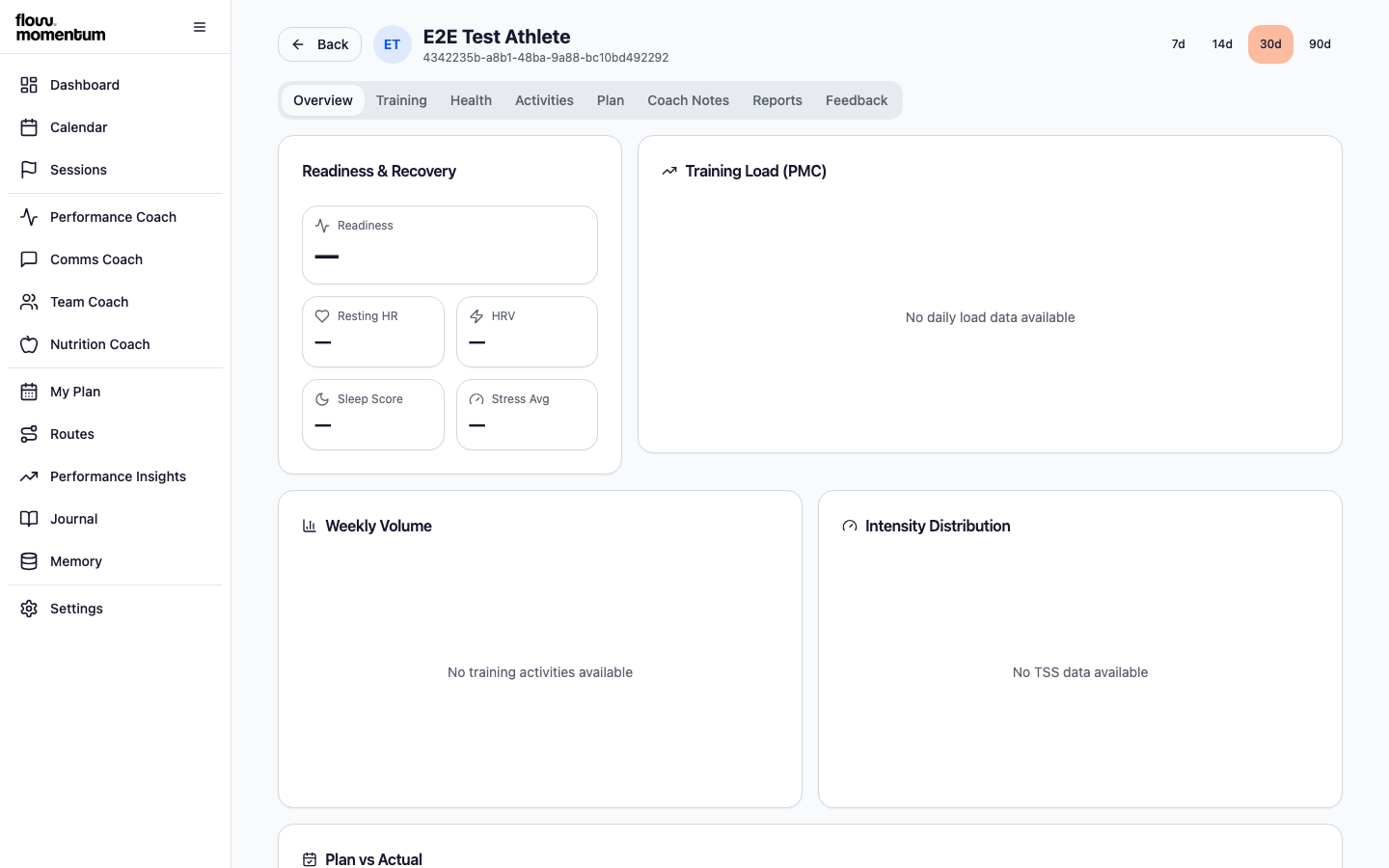
The coach experience adds a roster, coach-side file upload, athlete cockpits, notes, reports and an athlete-locked Coach Assistant. The coach selects one athlete before opening the analysis or assistant, reducing the risk that context moves between athletes.
This is a substantial product change, but the underlying principle remains simple: a score is not a decision.
Why the athlete record matters
A six-month event build cannot be understood from a seven-day snapshot.
Flow Momentum is designed to retain supported training records over time, including manually uploaded files. This matters for athletes whose data does not arrive through Garmin or Strava, and for coaches who receive files directly from an athlete.
The record is source-aware but the coaching view is not built around a device brand. Distance, duration, heart rate, power, pace and calculated load should be interpreted according to the available evidence and the athlete's sport.
A 2026 review in Sports Medicine describes monitoring as repeated, systematic data collection used to track change over time. It also argues that monitoring should support practitioner decisions rather than determine outcomes on its own.
That distinction is central to Flow Momentum.
Why cycling, running and triathlon need different views
A cyclist may need power, FTP context, elevation and ride-specific demands. A runner needs pace, durability, long-run balance and volume progression. A triathlete needs discipline balance, brick sessions and combined fatigue across swim, bike and run.
The new athlete experience therefore changes with the selected sport focus.
The aim is not to display every possible metric. It is to present the few signals that help answer the relevant coaching question, while labelling missing inputs as unavailable.
What the daily performance impulse does
The daily performance impulse combines deterministic load, recovery and race-readiness logic into one short, athlete-facing summary.
It can prioritise recovery, an easy day, continued building, intensity or race-specific work. It also shows its reasons, confidence and unavailable inputs.
The sentence is not generated from thin air. Underneath it sit explicit calculations and stored athlete data. AI can help explain the result, but it should not invent the inputs.
This separation between calculation and interpretation is explained in more detail on the Data and AI page.
What the coach workspace adds
Human coaches need more than a duplicate athlete dashboard.
The Coach Workspace is designed around the professional workflow:
| Coaching task | Workspace support |
|---|---|
| Organise athletes | Managed and claimed athlete records in a roster |
| Receive training data | Authorised coach-side file upload |
| Investigate a change | Load, recovery and activity analysis |
| Record judgement | Private notes and confirmed athlete learnings |
| Communicate progress | Structured reports that can be shared |
| Ask an open question | Athlete-locked Coach Assistant |
The assistant supports the coach. It does not replace accountability, direct observation or the conversation with the athlete.
Ask Flow Momentum
An athlete could ask:
"What does my available training and recovery data support today, and what information is still missing?"
A coach could ask:
"Compare this athlete's last four weeks with the previous four. Separate measured changes, calculated load and your interpretation."
A useful response should show the evidence, state the uncertainty and leave the final decision with the athlete or coach.
Try this week
Take one training decision you usually make from a single number.
Write down the other evidence that should influence it: recent training, recovery, event timing, athlete feedback and missing data.
That list is the beginning of a better decision system.
Frequently asked questions
Closing thought
The purpose of better athlete software is not to produce more data. It is to preserve context long enough for the next decision to improve.
Sources
Get the next Note
Practical ideas on performance, recovery, AI and better work — straight to your inbox.