Critical Swim Speed Explained: How to Test It and Why the Number Can Mislead
What CSS measures, how to run a 400/200 m test, and why a better 200 m can make your CSS look worse.
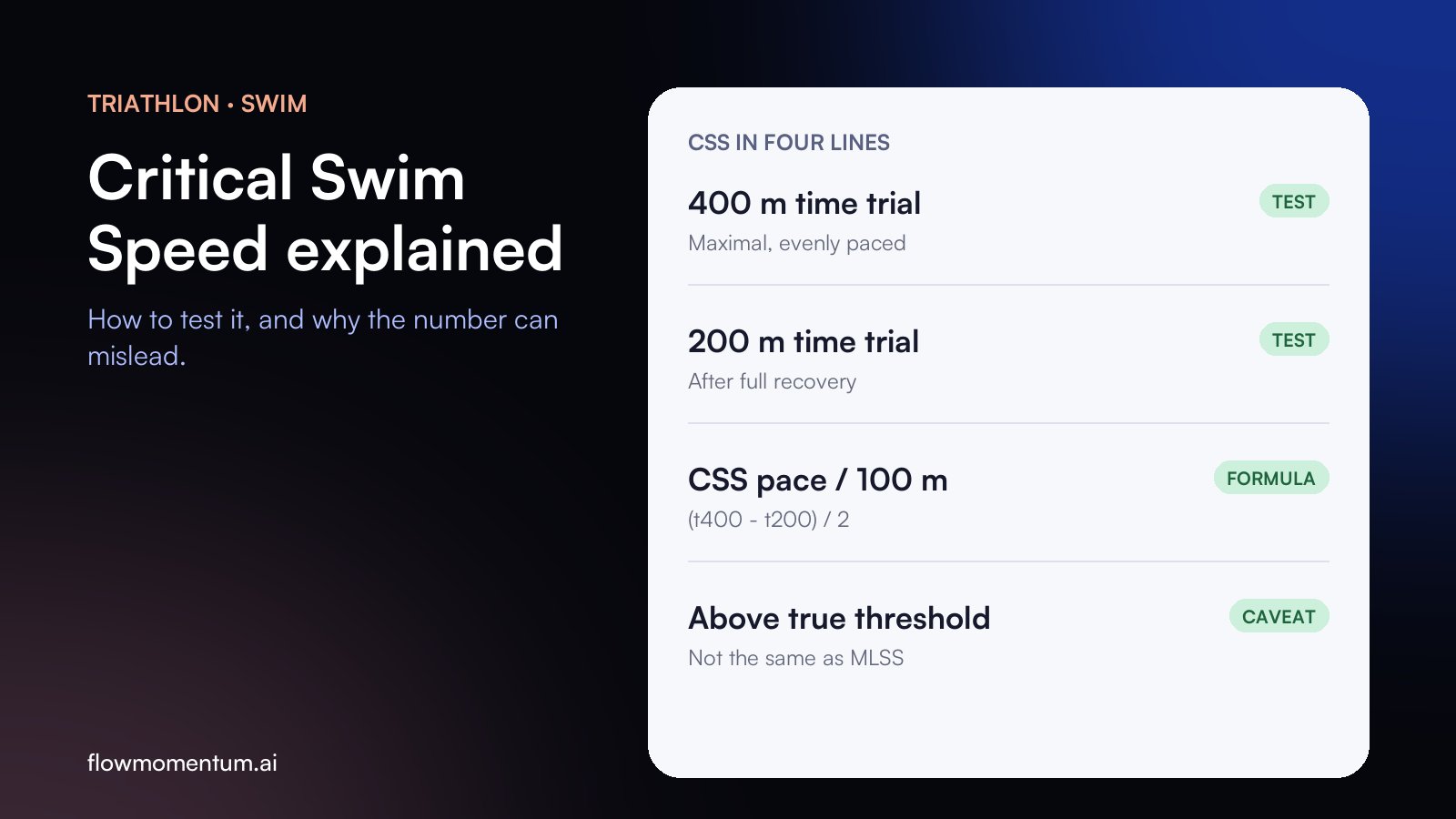
In short: Critical Swim Speed (CSS) is the slope of the distance–time line from two maximal swims, usually 400 m and 200 m. It is a practical pacing anchor for triathletes. It is not the same as your lactate threshold: it sits faster than the speed you can hold in a true steady state. And because it depends on the gap between two short trials, pacing errors move the number more than fitness does.
Many age-group triathletes test CSS once and then wonder why the number behaves strangely. One common question on r/triathlon, paraphrased: if I had tanked the 200, my CSS would look much better – so what is it actually measuring? (r/triathlon, 2025).
That question is the right one to ask.
What CSS measures
CSS comes from the critical power concept. Wakayoshi and colleagues applied it to swimming in 1992: swim several maximal distances, plot distance against time, and the slope of the line is the critical speed (Wakayoshi et al., 1992).
In practice, most triathletes use just two points:
- CSS (m/s) = (400 − 200) ÷ (t400 − t200)
- CSS pace per 100 m = (t400 − t200) ÷ 2
Example: 400 m in 7:20 (440 s), 200 m in 3:30 (210 s). The gap is 230 s, so CSS pace is 1:55 per 100 m.
CSS is faster than your true threshold
Dekerle and colleagues compared CSS with the speed at maximal lactate steady state (MLSS) in well-trained swimmers. CSS was significantly faster than MLSS speed. The two were strongly correlated (r = 0.87), but the limits of agreement were too wide to use them interchangeably (Dekerle et al., 2005).
What that means in the pool:
- A long set swum exactly at CSS pace is harder than "threshold" suggests. Many athletes cannot hold it for long continuous efforts.
- CSS is a good anchor for interval work with short rests, such as 100 m repeats.
- For long steady sets, swim a little slower than CSS.
How to run a 400/200 m test
- Warm up for 10–15 minutes, including a few short builds.
- Swim 400 m as fast as you can sustain, from a push start. Aim for even splits.
- Recover fully with easy swimming for 5–10 minutes.
- Swim 200 m maximal, again from a push start.
- Cool down.
Rules that keep the result useful:
- The 200 m must be faster per 100 m than the 400 m. If it is not, you did not recover or you paced the 400 m too hard. Retest another day.
- Pace both trials evenly. A fast first 100 m followed by a fade distorts the line.
- Use the same pool length and similar conditions each time you retest. Water temperature and lane traffic matter.
- Retest every few weeks in a training block, not after every session.
Why a better 200 m can make CSS look worse
CSS depends on the gap between your two times, not on either time alone.
- Faster 200 m, same 400 m: the gap grows, so CSS gets slower.
- Faster 400 m, same 200 m: the gap shrinks, so CSS gets faster.
- A deliberately easy 200 m shrinks the gap and flatters CSS.
So if your sprint speed improves faster than your endurance, CSS can drop even though you swim better. That is not a mistake in the formula. It shows that two short trials capture a narrow slice of your swimming.
When technique is the limiter
For adult beginners, CSS often reflects technique more than fitness. A UK poster who started swimming from zero in September 2025 described taking weekly lessons and following a plan, yet only managing 250–500 m continuously by January (r/triathlon, January 2026).
If you cannot swim 400 m continuously with stable form, a CSS test will not tell you much. Build continuous swimming and technique first, ideally with a coach or a masters group. Test once 400 m feels controlled.
CSS and swim training load
Platforms use CSS to estimate swim training load. TrainingPeaks, for example, calculates swim TSS from your pace relative to your threshold pace and the moving time of the session (TrainingPeaks). That is an industry convention, not a validated physiological dose. It also depends on accurate moving time and distance, which watches often get wrong in busy lanes.
An alternative with research support is session RPE: session duration multiplied by how hard the whole session felt. In well-trained swimmers, session RPE correlated significantly with heart-rate-based load and with distance (Wallace et al., 2009).
Where Flow Momentum stands today
We would rather say this clearly than leave it in the small print:
- You can enter your CSS from a 400/200 m test. If you have not, Flow Momentum estimates it from your fastest sustained swims of at least 400 m. A test result you enter always takes priority.
- Swim training load does not yet use CSS. It is a fixed-intensity estimate from duration. A hard interval set and an easy technique session of the same length currently count the same.
- Bike and run analysis is complete. We explain every formula in how Flow Momentum calculates your numbers.
That is why our triathlon page says "bike and run in full, swim load as an estimate". When CSS-based swim load is live, we will say so.
Try this week
Book one pool session for a 400/200 m test. Note your splits, the pool length and the water temperature. Then swim one set of 8–10 × 100 m at CSS pace with 15–20 seconds rest, and see whether the last repeats still feel controlled. If they do not, your working pace for long sets is slower than CSS.
Frequently asked questions
Closing thought
CSS is a useful number when you know what it is: a pacing anchor from two short swims, faster than your true threshold and sensitive to how you pace the test. Used that way, it makes swim training more structured without pretending to more precision than it has.
Sources
- Dekerle J et al. (2005). Critical swimming speed does not represent the speed at maximal lactate steady state. Int J Sports Med 26(7):524–530. doi:10.1055/s-2004-821227
- TrainingPeaks. Calculating swimming TSS score. Accessed 24 October 2026.
- Wakayoshi K et al. (1992). A simple method for determining critical speed as swimming fatigue threshold in competitive swimming. Int J Sports Med 13(5):367–371. doi:10.1055/s-2007-1021282
- Wallace LK, Slattery KM, Coutts AJ (2009). The ecological validity and application of the session-RPE method for quantifying training loads in swimming. J Strength Cond Res 23(1):33–38. UTS repository
- Reddit r/triathlon. Help me understand critical swim speed (2025); Advice – new triathlete, swimming issues (January 2026). Accessed 24 October 2026.
Get the next Note
Practical ideas on performance, recovery, AI and better work — straight to your inbox.