Your First 70.3 With a Full-Time Job: A UK Guide to an 8–10 Hour Week
How working age-groupers fit swim, bike and run into a busy week, what the evidence says about intensity, and how to choose a first UK race.
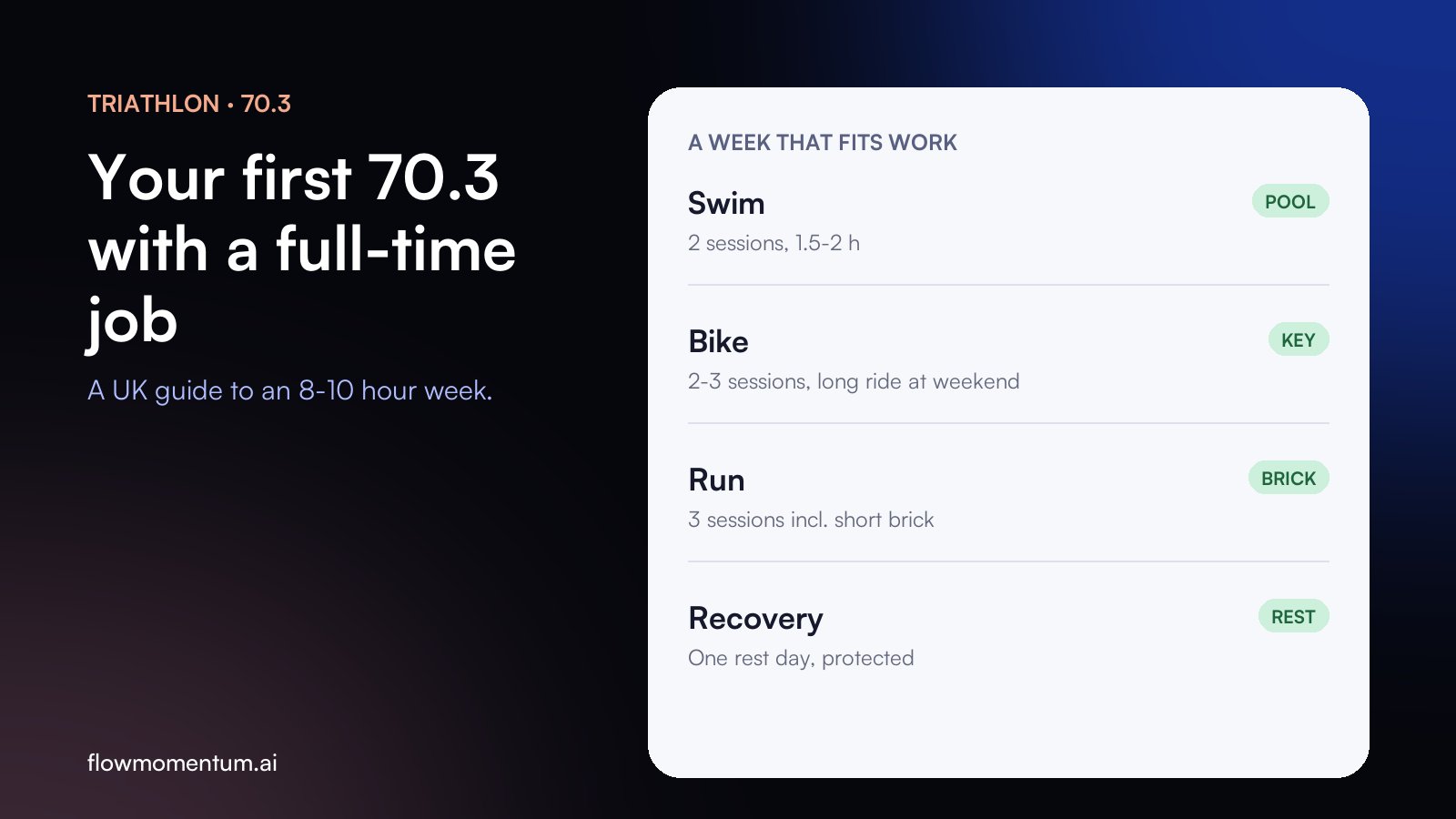
In short: A first 70.3 fits around a full-time job when the week has about two swims, two or three rides, three runs and one short brick, with the long ride and long run protected at the weekend. Research on recreational triathletes shows that polarised and pyramidal training both work, so choose the structure you can repeat. Pick a first UK race for its swim and logistics, not its reputation.
Most first-time 70.3 athletes in the UK are not short of motivation. They are short of time. Early pool sessions, weekend long rides and a job that does not stop at five o'clock are the recurring themes in UK triathlon forums.
Start with the week you can repeat
A useful starting point for 8–10 hours a week:
| Discipline | Time per week | Sessions | Focus |
|---|---|---|---|
| Swim | 1.5–2 h | 2 | One technique and aerobic session, one interval session |
| Bike | 4–5 h | 2–3 | One long weekend ride, one structured indoor session |
| Run | 2–2.5 h | 3 | One easy run, one steady or tempo run, one short brick |
This is an example, not a prescription. A few principles matter more than the exact numbers:
- Protect two anchors: the long ride and the long run. Everything else can move.
- Use the commute and lunch break for easy runs or rides where you can. They add volume without taking time from the evening.
- Book pool sessions like meetings. Early swims are the session most often lost to work and childcare.
- One rest day. Recovery is when the training turns into fitness.
Intensity: polarised or pyramidal?
Polarised training puts most time at low intensity, a small share at high intensity and very little in between. Pyramidal training adds more moderate, tempo-type work.
Selles-Perez and colleagues followed recreational triathletes through 13 weeks of half-distance preparation. Both groups improved in all three disciplines, and total race times were almost identical (Selles-Perez et al., 2019). The groups were small, so the authors suggested that training volume and experience may matter more than the distribution itself.
For a time-limited athlete, that is good news. You do not need a perfect model. You need:
- most sessions easy enough to recover from,
- one or two sessions a week with clear quality,
- some race-pace work in the last eight weeks.
Bricks: short and regular
Running straight off the bike feels heavy for a reason. A review of the cycle-to-run transition found that running energy cost after cycling was 1.6% to 11.6% higher than when running fresh, and that triathletes run with a more forward-leaning trunk (Millet and Vleck, 2000).
For a first 70.3, keep bricks simple:
- 10–20 minutes of easy running straight after a ride, once a week.
- In the last six to eight weeks, one or two longer bricks at race effort.
- Practise transitions: kit laid out, shoes on fast, first kilometre controlled.
Choosing a first UK 70.3
UK age-groupers choosing a first half-distance race tend to weigh the swim, the course profile and the logistics. Threads in 2025 and 2026 compared Ironman 70.3 Bolton (lake swim, hilly bike, split transitions), Swansea (harbour swim), Weymouth (where a sea swim had been cancelled in a previous edition) and the Outlaw Half in Nottingham (r/triathlon, September 2025; r/triathlon, October 2025).
Questions worth asking before you enter:
- Swim: lake, harbour or sea? How confident are you in open water and cold conditions?
- Bike: hilly or flat? Can you train for that terrain near home?
- Logistics: one transition or two? How far is it from home, and do you need a hotel?
- Rules and membership: check the race's wetsuit rules and whether you need British Triathlon membership or a day licence.
When work wins: what to drop first
Busy weeks happen. Decide in advance what goes:
- A second interval session goes before the long ride or long run.
- A short brick can become a normal easy run.
- A missed swim is fine once. Two missed weeks of swimming will show on race day.
- Do not stack missed sessions onto the weekend. Move one, drop the rest.
Where Flow Momentum fits
Flow Momentum analyses your bike and run training in full: power, FTP, Critical Power, pace, Critical Speed, training load and recovery signals such as sleep and HRV. Goals and programmes understand triathlon, and you can upload FIT, GPX or TCX files from any device.
Swimming is the current limit. You can enter your CSS, but swim training load is still a fixed-intensity estimate, so a hard swim set and an easy one of the same length count the same. Read your combined weekly load with that in mind. Our note on Critical Swim Speed explains the test and its limits.
For fitting endurance training into a working week more generally, see training around work and commuting and Flow Momentum for busy professionals. Base and Peak are currently on a launch waitlist.
Try this week
Write down your fixed points: work, family, pool opening times. Put the long ride, long run and two swims into the calendar first. Then add the rest. If the week only works on paper when everything goes right, remove one session.
Frequently asked questions
Closing thought
A first 70.3 is less about finding more time than about using the time you have consistently. Two anchors, a few quality sessions and a plan for busy weeks will get most working age-groupers to the finish line in good shape.
Sources
- Millet GP, Vleck VE (2000). Physiological and biomechanical adaptations to the cycle to run transition in Olympic triathlon: review and practical recommendations for training. Br J Sports Med 34(5):384–390. PMC1756235
- Selles-Perez S, Fernández-Sáez J, Cejuela R (2019). Polarized and pyramidal training intensity distribution: relationship with a half-ironman distance triathlon competition. J Sports Sci Med 18(4):708–715. PMC6873141
- Reddit r/triathlon. First 70.3 – help me pick (September 2025); Choosing my first UK 70.3 – any tips? (October 2025). Accessed 24 October 2026.
Get the next Note
Practical ideas on performance, recovery, AI and better work — straight to your inbox.