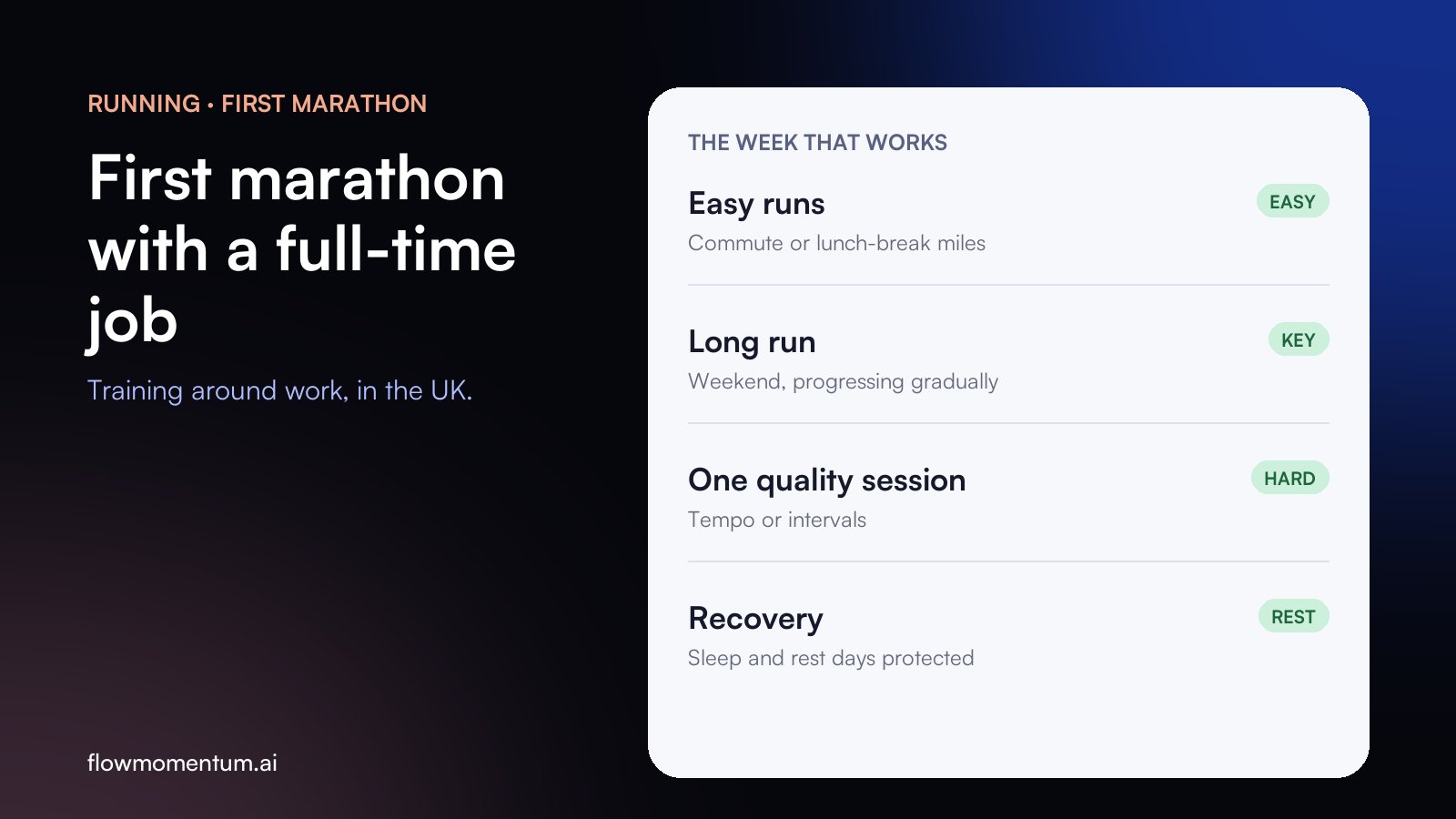
First Marathon With a Full-Time Job: A UK Training Guide
How to build towards 42.2 km when work, commuting and a UK winter decide most of your week.
In short: A first marathon fits around a full-time job when the week has three to five runs, most of them easy, one long run you protect in the diary and at least one rest day. Increase distance slowly, rehearse fuelling on the long run and taper for about three weeks. Watch how your heart rate drifts late in long runs. It tells you more about readiness than one fast 5K.
Most people who run their first marathon do not have spare time. They have a job, a commute, a family diary and a dark UK winter between them and race day.
That is not a reason to skip the marathon. It is a reason to plan the week around the time you actually have.
Start from the race date, then count back
Pick the race first. The 2027 London Marathon runs over two days, on Saturday 24 and Sunday 25 April 2027. Counting back 16 weeks from 25 April takes you to early January. So a spring marathon in the UK means most of the build happens in winter, often before or after work in the dark.
Sixteen weeks is a common length for a first-marathon build. It is not a law. If you can already run 30 to 40 minutes without stopping, 16 weeks gives you room for a slow increase and a proper taper. If you cannot, spend the weeks before the build on easy, regular running first. The free NHS Couch to 5K programme is a sensible starting point for complete beginners.
A week that fits around work
The useful question is not "what is the perfect marathon week?" It is "what can I repeat for 16 weeks?"
| Day | Session | Why it is there |
|---|---|---|
| Monday | Rest | Recovery after the long run, and the day work usually takes over |
| Tuesday | Easy run, 30–45 min | Aerobic base at low cost. Can be a run commute |
| Wednesday | Steady or interval session, 40–50 min | One quality session per week is enough for most first-timers |
| Thursday | Easy run or rest | The flexible day when work runs late |
| Friday | Rest or short easy run | Arrive fresh for the long run |
| Saturday or Sunday | Long run | The most important session of the week |
| Other weekend day | Easy run or rest | Optional extra volume |
This is an example, not a prescription. Three runs a week can be enough for a first marathon. Five are better only if you recover from them.
Two habits help more than any specific session:
- Put the long run in the diary like a meeting. Work rarely moves Saturday morning. It often moves Wednesday evening.
- Decide the fallback in advance. If Wednesday's session disappears, move it to Thursday or drop it. Do not stack it on top of the long run.
Easy runs are also the easiest to fit into the working day. A run commute turns travel time into training: leave a change of clothes at the office, run one way and take the train or bus back. A 30-minute lunch run at an easy pace works if you can shower at work. Neither replaces the long run, but together they can cover most of your easy volume without taking extra time from the evening.
Keep most of your running easy
When time is short, the temptation is to make every run count by running it hard. For a marathon, that usually backfires.
A widely cited review of competitive endurance athletes found that about 80% of their sessions were at low intensity and about 20% were dominated by hard work such as intervals (Seiler, 2010). Those athletes train 10 to 13 times a week, so their numbers do not transfer one to one. The principle does: most of the running should feel comfortable enough to talk.
Easy running builds the aerobic base the marathon depends on. It also leaves enough energy for the one session that should feel hard, and for the long run.
Increase distance slowly
Novice runners get injured more often than experienced ones. A systematic review of 86 studies found time-loss injury proportions from 3.2% in cross-country runners to 84.9% in novice runners (Kluitenberg et al., 2015). The studies differed a lot in how they defined an injury, so the figure is a warning sign, not a precise risk.
How fast you increase distance matters too. In a one-year study of 874 novice runners, those who increased their weekly distance by more than 30% over two weeks tended to have more overuse injuries, such as runner's knee and shin pain, than those who increased it by less than 10% (Nielsen et al., 2014). The authors call the finding exploratory. It is still a useful ceiling.
In practice:
- Increase the weekly total in small steps, and hold it for a week before the next step.
- Plan an easier week every three to four weeks.
- Treat pain that changes how you run as a reason to stop and get it assessed by a physiotherapist or doctor.
The long run: practise the race, not just the distance
The long run builds endurance. It is also where you practise everything you need on race day: pacing, fuelling, kit and the mental side of running for hours.
Fuelling deserves real practice. The joint position statement of the American College of Sports Medicine, the Academy of Nutrition and Dietetics and Dietitians of Canada recommends about 30 to 60 g of carbohydrate per hour for exercise of one to two and a half hours, and up to 90 g per hour for longer efforts (Thomas, Erdman and Burke, 2016). Most first-time marathon runners are out for well over three hours. Your gut needs training to take that on, so use the long runs to test gels, drinks and timing.
Durability: the number that matters late in the race
A marathon is rarely lost in the first 10 km. It is lost after 30.
Researchers call the ability to resist that late decline durability: how late and how much your physiology starts to change during prolonged exercise (Maunder et al., 2021). A study of 82,303 recreational marathon runners measured it as the decoupling between heart rate and speed. On average, decoupling first appeared about 25 km into the race. Runners with low decoupling ran faster and started to decouple later (Smyth et al., 2022).
You can see the same pattern in your long runs. If your heart rate keeps rising while your pace stays the same, or your pace drops while your heart rate stays the same, you are starting to decouple. When that happens later in the long run than a few weeks ago, your durability is improving.
Flow Momentum shows this for every long run. It calculates the decoupling of heart rate against running power, rates your fatigue resistance over long runs and estimates your critical speed from your fastest efforts. We explain the formulas in how Flow Momentum calculates your numbers.
Taper properly
In the final weeks, less is more. An analysis of more than 158,000 recreational marathon runners found that strict tapers, with weekly distance falling step by step, were associated with better race times than relaxed ones. Strict three-week tapers came out best: a median finish-time saving of about 5.5 minutes (2.6%) compared with a minimal taper. Yet 64% of the runners used less disciplined tapers (Smyth and Lawlor, 2021).
For a first marathon, plan three weeks in which distance falls each week. Keep a little faster running in the week so your legs stay sharp, but no new sessions and no "one last long run".
When work wins: what to drop first
Some weeks, work will win. Decide in advance what goes first:
- Drop the extra easy run. It adds the least.
- Shorten the quality session. Keep a few efforts, skip the rest.
- Protect the long run. If it has to move, move it, do not cut it in half every week.
- Protect sleep. Most adults need at least seven hours a night on a regular basis (Watson et al., 2015). A 5 am run after five hours of sleep is rarely the best use of the morning.
Our companion note on when to protect an easy day shows how HRV, sleep and durability data can help you make that call.
How Flow Momentum fits in
Flow Momentum reads your runs from Garmin or from uploaded FIT, GPX or TCX files. For running, it shows:
- pace and your fastest distances, with stop rules so that pauses at traffic lights do not distort them;
- running power in watts and critical speed;
- fatigue resistance over long runs and the decoupling of heart rate against running power;
- a rating of each session, so you can see how it fitted the week.
A coach can see the same data in the coach view and analyse any window of a run.
There are limits. Running training load is calculated from pace and is not yet linked to your critical running power. Garmin does not pass running dynamics such as ground contact time to Flow Momentum. Strava is only available in a limited form, so Garmin or a file upload is the more reliable route.
Base costs £19 a month and Peak £49 a month at launch. Both are currently on a launch waitlist. Peak adds group coaching and direct access to Hartmut. See the plans on the pricing page or Flow Momentum for runners.
Try this week
Run your next long run at an easy, conversational pace. Afterwards, compare your heart rate in the first and the last 20 minutes at a similar pace. Write the difference down. Repeat in four weeks. That one number tells you more about your marathon readiness than any single fast run.
Frequently asked questions
Closing thought
A first marathon around a full-time job is mostly a planning problem. Easy running, a protected long run and slow progress over 16 weeks will take you further than a heroic week you cannot repeat.
Sources
- London Marathon Events. TCS London Marathon 2027 dates. Accessed 24 October 2026.
- Kluitenberg B, van Middelkoop M, Diercks R, van der Worp H (2015). What are the differences in injury proportions between different populations of runners? A systematic review and meta-analysis. Sports Med 45:1143–1161. doi:10.1007/s40279-015-0331-x
- Maunder E, Seiler S, Mildenhall MJ, Kilding AE, Plews DJ (2021). The importance of "durability" in the physiological profiling of endurance athletes. Sports Med 51:1619–1628. doi:10.1007/s40279-021-01459-0
- NHS Better Health. Get running with Couch to 5K.
- Nielsen RO et al. (2014). Excessive progression in weekly running distance and risk of running-related injuries: an association which varies according to type of injury. J Orthop Sports Phys Ther 44:739–747. doi:10.2519/jospt.2014.5164
- Seiler S (2010). What is best practice for training intensity and duration distribution in endurance athletes? Int J Sports Physiol Perform 5:276–291. doi:10.1123/ijspp.5.3.276
- Smyth B, Lawlor A (2021). Longer disciplined tapers improve marathon performance for recreational runners. Front Sports Act Living 3:735220. doi:10.3389/fspor.2021.735220
- Smyth B, Maunder E, Meyler S, Hunter B, Muniz-Pumares D (2022). Decoupling of internal and external workload during a marathon: an analysis of durability in 82,303 recreational runners. Sports Med 52:2283–2295. doi:10.1007/s40279-022-01680-5
- Thomas DT, Erdman KA, Burke LM (2016). American College of Sports Medicine joint position statement: Nutrition and athletic performance. Med Sci Sports Exerc 48:543–568. doi:10.1249/MSS.0000000000000852
- Watson NF et al. (2015). Recommended amount of sleep for a healthy adult: a joint consensus statement of the American Academy of Sleep Medicine and Sleep Research Society. Sleep 38:843–844. doi:10.5665/sleep.4716
Get the next Note
Practical ideas on performance, recovery, AI and better work — straight to your inbox.