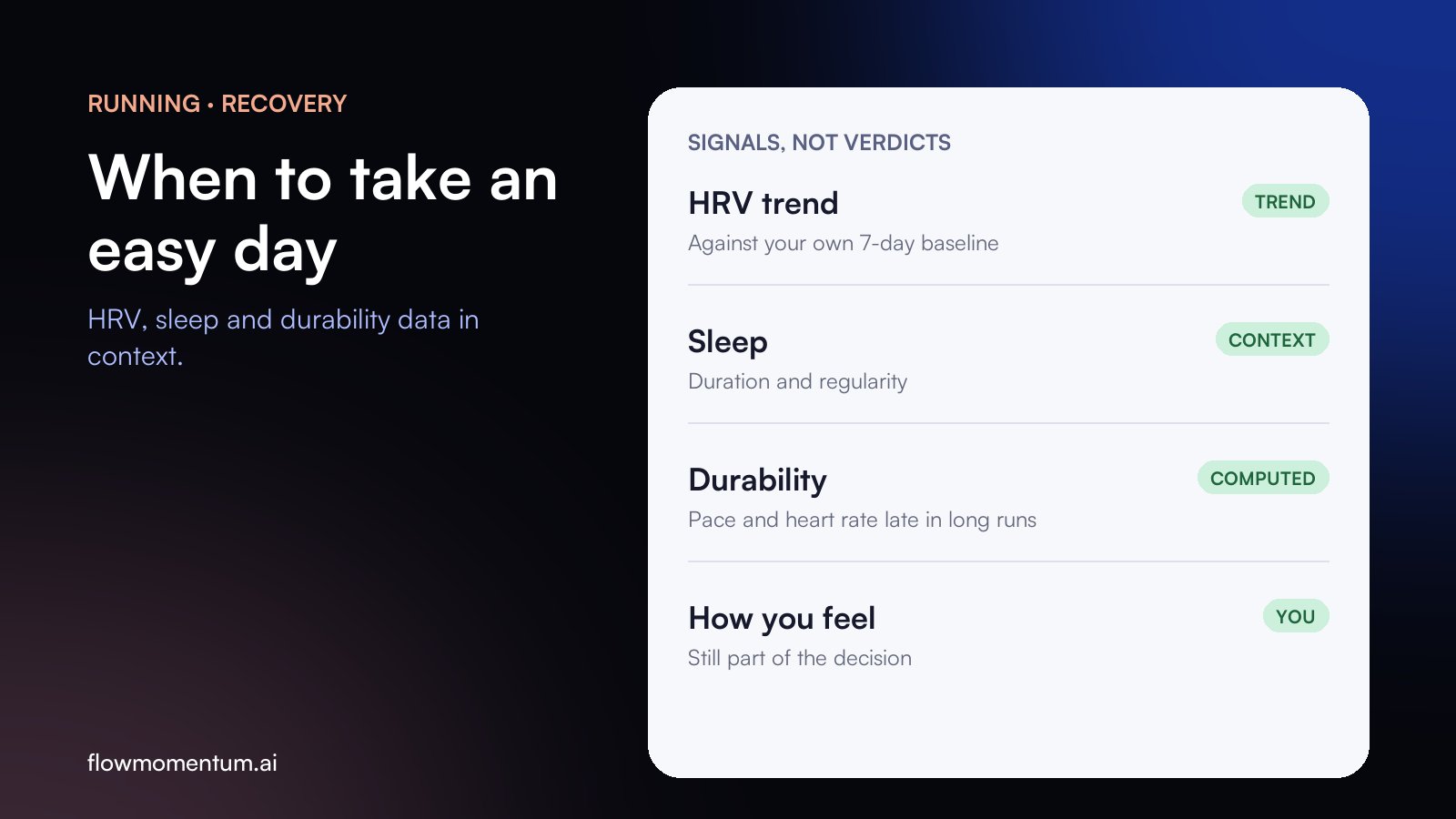
When to Take an Easy Day: Using HRV, Sleep and Durability Data
How runners can read morning HRV, sleep and long-run durability together, and when the data says to protect a recovery day.
In short: One low HRV reading is not a reason to rest. A 7-day HRV trend below your baseline, combined with short sleep or a raised resting heart rate, often is. Durability data from your long runs adds the slower picture: if your heart rate decouples earlier than it used to, your body is not absorbing the load. When two or more signals point the same way, swap the hard session for an easy run and keep the week moving.
Every runner knows the morning question. The plan says intervals. Your legs say no. Your watch shows a number in orange.
Most of the time, the right answer is not to skip training. It is to choose the right kind of training. Easy days are part of the plan, not a break from it.
What HRV can and cannot tell you
Heart rate variability (HRV) measures the small changes in time between heartbeats. Watches usually record it overnight. In endurance training, falling HRV has been linked to poor adaptation and rising HRV to good adaptation. The picture is not always that simple: in elite athletes, both directions have been seen alongside fatigue (Plews et al., 2013). HRV is best read as one signal among several, together with training logs and how you feel (Buchheit, 2014).
Two studies tested this in practice with runners.
- Kiviniemi et al. (2007) split 26 moderately fit men into groups. One followed a fixed plan. The other ran hard only when morning HRV had not dropped, and easy or not at all when it had. After four weeks, the HRV group improved maximal running speed more than the fixed-plan group.
- Vesterinen et al. (2016) studied 40 recreational endurance runners over eight weeks. The HRV group scheduled moderate and hard sessions only when HRV was within their normal range. They did fewer hard sessions (about 13 against 18). Their 3000 m time improved by 2.1%, while the fixed-plan group's improvement of 1.1% was not significant.
A meta-analysis of randomised trials found a small advantage for HRV-guided training on VO2max, clearer in amateur and female athletes (Granero-Gallegos et al., 2020). The evidence is encouraging, but the studies are small.
The key lesson: HRV-guided training did not mean less running. It meant better timing of the hard days.
Why one morning is not enough
Daily HRV is noisy. Plews et al. (2013) recommend averaging techniques rather than reacting to single readings. Buchheit (2014) adds that a change only matters when it is larger than the measurement error and the smallest important change for that person.
Flow Momentum uses an open version of this method. It takes the log of each night's RMSSD, compares your 7-day mean with your baseline of the 53 nights before, and needs at least 14 valid nights before it shows a status. The full formula is in how Flow Momentum calculates your numbers.
Sleep: the signal you can act on tonight
Sleep is the most practical recovery lever for most runners with a job.
A review of sleep loss and exercise found mixed effects. Some maximal efforts can be maintained after a bad night. Sport-specific performance and cognitive function, such as reaction time and decision-making, tend to suffer more (Fullagar et al., 2015). Most adults need at least seven hours a night on a regular basis (Watson et al., 2015).
For a runner, that means a short night does not ban training. It does make a hard interval session a worse bet, especially if it repeats over several nights.
Durability: the slower signal from your long runs
HRV and sleep change from day to day. Durability changes over weeks.
Durability is how late and how much your physiology starts to change during prolonged exercise (Maunder et al., 2021). Jones (2024) calls this physiological resilience a "fourth dimension" of endurance performance, alongside VO2max, economy and threshold. In cycling, critical power fell by about 10% on average after two hours of heavy exercise, with large differences between people.
For runners, the clearest data comes from the marathon. In 82,303 recreational runners, heart rate and speed first decoupled about 25 km into the race on average. Runners with low decoupling ran faster and decoupled later (Smyth et al., 2022).
You can use the same idea in training. If your heart rate drifts earlier in a familiar easy long run than it did a few weeks ago, your body may not be absorbing the load. That is a reason to make the next few days easier, even if HRV looks normal.
A simple decision table
| Signal | What it suggests | What to do today |
|---|---|---|
| 7-day HRV within baseline, sleep normal | Ready for the planned session | Run as planned |
| One low HRV morning, everything else normal | Probably noise | Run as planned, check again tomorrow |
| 7-day HRV below baseline | Accumulated stress | Swap hard for easy, keep the long run if it is easy |
| Under seven hours of sleep on several nights | Recovery deficit | Easy run, and an earlier night |
| Resting heart rate clearly above normal, or feeling unwell | Possible illness | Rest. Get medical advice if it persists |
| Earlier heart-rate drift on a familiar long run | Fading durability | Reduce load for a few days, review the week |
| Two or more of the above | Clear signal | Protect a recovery day |
This is a guide, not a medical rule. Pain, chest symptoms, dizziness or illness always need a doctor, not a training app.
How Flow Momentum helps you make the call
Flow Momentum brings these signals into one view for runners:
- your open HRV status against your own baseline, plus sleep duration and bedtime regularity;
- fatigue resistance over long runs and the decoupling of heart rate against running power;
- critical speed estimated from your fastest efforts, and a rating of each session.
You can ask the Performance Coach whether today should be easy, and it answers from your data, labelled with where each number comes from. A coach can see the same picture in the coach view.
The limits matter. The combined readiness score is still in shadow mode while we calibrate it. Running training load is calculated from pace and not yet linked to your critical running power. Garmin does not pass running dynamics to Flow Momentum, and Strava is only available in a limited form, so Garmin sync or a FIT, GPX or TCX upload works best.
Base costs £19 and Peak £49 a month at launch, both on a launch waitlist. See the plans or read more about Flow Momentum for runners.
If you are building towards a first marathon, our guide to marathon training around a full-time job shows how easy days fit into the week.
Try this week
Before your next hard session, check three things: your 7-day HRV trend, your sleep over the last three nights and how your heart rate behaved on your last long run. If two of them look worse than usual, run easy and do the session two days later. Write down how the delayed session felt.
Frequently asked questions
Closing thought
An easy day is not lost training. It is how a hard week turns into fitness instead of fatigue.
Sources
- Fullagar HHK et al. (2015). Sleep and athletic performance: the effects of sleep loss on exercise performance, and physiological and cognitive responses to exercise. Sports Med 45:161–186. doi:10.1007/s40279-014-0260-0
- Buchheit M (2014). Monitoring training status with HR measures: do all roads lead to Rome? Front Physiol 5:73. doi:10.3389/fphys.2014.00073
- Granero-Gallegos A, González-Quílez A, Plews D, Carrasco-Poyatos M (2020). HRV-based training for improving VO2max in endurance athletes: a systematic review with meta-analysis. Int J Environ Res Public Health 17:7999. doi:10.3390/ijerph17217999
- Jones AM (2024). The fourth dimension: physiological resilience as an independent determinant of endurance exercise performance. J Physiol 602:4113–4128. doi:10.1113/JP284205
- Kiviniemi AM, Hautala AJ, Kinnunen H, Tulppo MP (2007). Endurance training guided individually by daily heart rate variability measurements. Eur J Appl Physiol 101:743–751. doi:10.1007/s00421-007-0552-2
- Maunder E, Seiler S, Mildenhall MJ, Kilding AE, Plews DJ (2021). The importance of "durability" in the physiological profiling of endurance athletes. Sports Med 51:1619–1628. doi:10.1007/s40279-021-01459-0
- Plews DJ et al. (2013). Training adaptation and heart rate variability in elite endurance athletes: opening the door to effective monitoring. Sports Med 43:773–781. doi:10.1007/s40279-013-0071-8
- Smyth B, Maunder E, Meyler S, Hunter B, Muniz-Pumares D (2022). Decoupling of internal and external workload during a marathon: an analysis of durability in 82,303 recreational runners. Sports Med 52:2283–2295. doi:10.1007/s40279-022-01680-5
- Vesterinen V et al. (2016). Individual endurance training prescription with heart rate variability. Med Sci Sports Exerc 48:1347–1354. doi:10.1249/MSS.0000000000000910
- Watson NF et al. (2015). Recommended amount of sleep for a healthy adult: a joint consensus statement of the American Academy of Sleep Medicine and Sleep Research Society. Sleep 38:843–844. doi:10.5665/sleep.4716
Get the next Note
Practical ideas on performance, recovery, AI and better work — straight to your inbox.