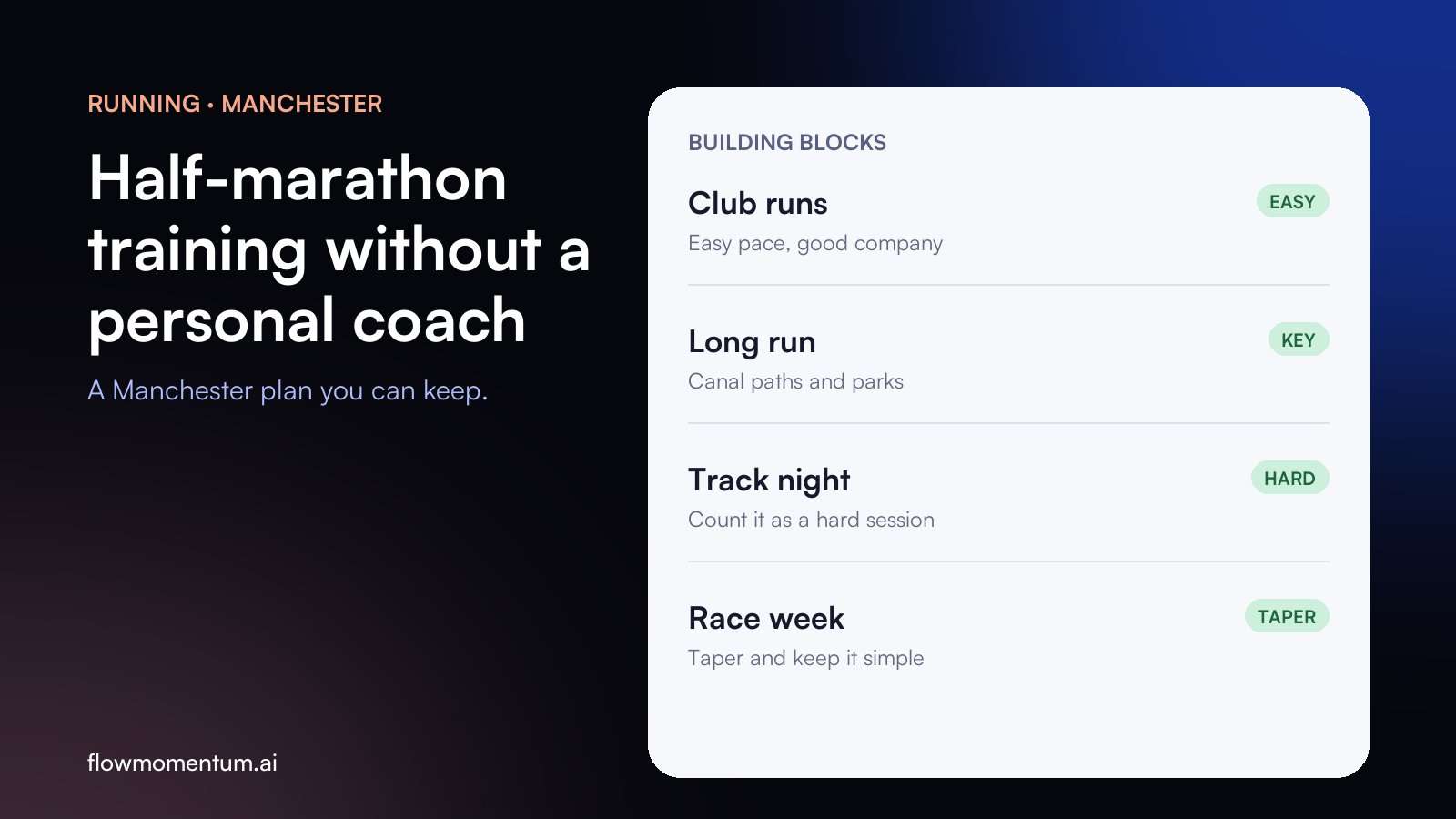
Half-Marathon Training in Manchester Without a Personal Coach
How to combine free group runs, parkrun, a clear plan and your own data into coaching that fits a Manchester week.
In short: You can prepare well for a Manchester half marathon without a personal coach. Run most sessions easy, add one quality session a week, join a running club or a free RunTogether group for company, use parkrun as a regular check and let your own data tell you when to change the plan. Pay for human coaching when you need judgement the data cannot give, such as recurring injury or a big change in goals.
Manchester has plenty of places to run and plenty of races. What self-coached runners often lack is not a route or a start line. It is structure and feedback.
A personal coach gives you both, but not everyone can or wants to pay for one. The good news: most of what a coach does for a first or second half marathon can be put together from free and low-cost pieces.
Pick the race and count back
The AJ Bell Great Manchester Run is on 23 May 2027, with a 10K and a half-marathon distance. It starts on Portland Street. Counting back 12 weeks takes you to late February.
Twelve weeks is a common length for a half-marathon build if you can already run 30 to 40 minutes without stopping. If you cannot, start with the free NHS Couch to 5K programme and build from there.
What a coach actually does, and the alternatives
| What a coach does | Free or low-cost alternative | Limit |
|---|---|---|
| Company and accountability | A running club or an England Athletics RunTogether group | Group pace may not match your plan |
| Regular fitness checks | parkrun, a free weekly 5 km event on Saturday mornings | A hard 5K every week is a hard session, not an easy run |
| A structured plan | A published 12-week plan with mostly easy running | It does not change when your week does |
| Adjusting to sleep, work and fatigue | Your own data, read against your baseline | Needs consistent data and a clear method |
| Judgement on injury and technique | A physiotherapist or a human coach | Costs money, but only when you need it |
RunTogether groups are led by qualified group leaders and range from walk-jog sessions for beginners to more challenging runs. England Athletics reports more than 2,000 groups set up since 2017. Most do not charge an annual membership, although some charge a small fee per session.
A 12-week structure that fits a working week
For three to four runs a week:
- One easy run of 30 to 45 minutes, on a canal path, in a park or as a run commute.
- One quality session, such as tempo running or intervals. A club or RunTogether session can cover this.
- One long run that grows from about 60 to about 100 minutes over the build.
- Optionally, parkrun as a steady run most weeks and an all-out effort every four weeks.
Keep most of the running easy. A widely cited review of competitive endurance athletes found that about 80% of their sessions were at low intensity (Seiler, 2010). You will train far less than they do, but the principle transfers.
Increase distance slowly. In a study of 874 novice runners, those who increased weekly distance by more than 30% over two weeks tended to have more overuse injuries than those who increased it by less than 10% (Nielsen et al., 2014). Plan an easier week every three to four weeks.
Pacing from your own data
It is easy to lose a half marathon in the first 5 km. The crowd, the music and fresh legs make it easy to start too fast.
Critical speed helps here. It is the highest speed at which your body can still reach a physiological steady state. Smyth and Muniz-Pumares (2020) estimated it from the raw training data of more than 25,000 recreational marathon runners and found it predicted marathon performance. Runners who ran the first half of the marathon above 94% of their critical speed were more likely to slow down by more than 25% in the second half.
A half marathon is shorter, but the lesson holds: a controlled first third protects the finish.
Flow Momentum estimates your critical speed from your fastest efforts in training. It applies stop rules, so that pauses at junctions in the city centre do not distort your fastest distances. It also shows running power in watts and how your heart rate decouples from power late in long runs. We explain the formulas in how Flow Momentum calculates your numbers.
Feedback without a coach
The piece most self-coached runners miss is feedback: when to push, when to hold and when to protect a recovery day.
That is where your own data helps. A falling HRV trend, short sleep and earlier heart-rate drift on a familiar long run are all reasons to make the next few days easier. Our note on when to take an easy day shows how to read them together.
Flow Momentum brings these signals into one place and rates each session against the week. You can ask the Performance Coach what to change when work, weather or fatigue get in the way. If you work with a coach on Flow Momentum, they can see the same data in the coach view.
The limits are clear. Running training load is calculated from pace, not yet from your critical running power. Garmin does not pass running dynamics to Flow Momentum, and Strava is only available in a limited form. Garmin sync or a FIT, GPX or TCX upload gives the most complete picture.
Base costs £19 and Peak £49 a month at launch, both on a launch waitlist. Peak adds group coaching and direct access to Hartmut. See the plans or Flow Momentum for runners.
When a human coach is worth paying for
Data and group runs cover a lot. They do not replace judgement in every situation. Consider a human coach or a physiotherapist when:
- the same injury comes back during each build;
- you have a health condition that affects training;
- you want to move from finishing to a specific time goal and have stalled;
- you need someone to look at your running technique in person.
Try this week
Run your next parkrun as a steady effort, not a race. Note your average heart rate and how you felt. Repeat the same effort in four weeks. If the pace is faster at the same heart rate, your base is building.
Frequently asked questions
Closing thought
A personal coach is one way to get structure and feedback. In Manchester, you can build most of both from group runs, parkrun and your own data, and pay for expertise only where it adds most.
Sources
- AJ Bell Great Run Series. AJ Bell Great Manchester Run. Accessed 24 October 2026.
- England Athletics. RunTogether. Accessed 24 October 2026.
- NHS Better Health. Get running with Couch to 5K.
- Nielsen RO et al. (2014). Excessive progression in weekly running distance and risk of running-related injuries: an association which varies according to type of injury. J Orthop Sports Phys Ther 44:739–747. doi:10.2519/jospt.2014.5164
- parkrun. Overview on Wikipedia. Accessed 24 October 2026.
- Seiler S (2010). What is best practice for training intensity and duration distribution in endurance athletes? Int J Sports Physiol Perform 5:276–291. doi:10.1123/ijspp.5.3.276
- Smyth B, Muniz-Pumares D (2020). Calculation of critical speed from raw training data in recreational marathon runners. Med Sci Sports Exerc 52:2637–2645. doi:10.1249/MSS.0000000000002412
Get the next Note
Practical ideas on performance, recovery, AI and better work — straight to your inbox.