Combined Training Load in Triathlon: Why One Number Is Not Enough
What a single fitness and fatigue score hides when you train three sports, and how to read your load when the swim metric is only approximate.
In short: A combined fitness, fatigue and form score across swim, bike and run is a useful overview, but it treats every point of training stress as equal. The scores come from different formulas, running stresses the body differently from swimming and cycling, and swim intensity is often poorly measured. Read your total load next to each sport's own trend, and treat the swim part with caution.
How combined load works
Training Stress Score (TSS) gives each session a number: one hour at threshold is 100. From daily TSS, many platforms calculate fitness (CTL, a 42-day weighted average), fatigue (ATL, a 7-day weighted average) and form (TSB, fitness minus fatigue). We explain the formulas in how Flow Momentum calculates your numbers.
For a triathlete, the simplest approach is to add every session to the same total. A 60-minute swim, a two-hour ride and a 45-minute run all land in one fitness line.
What one number hides
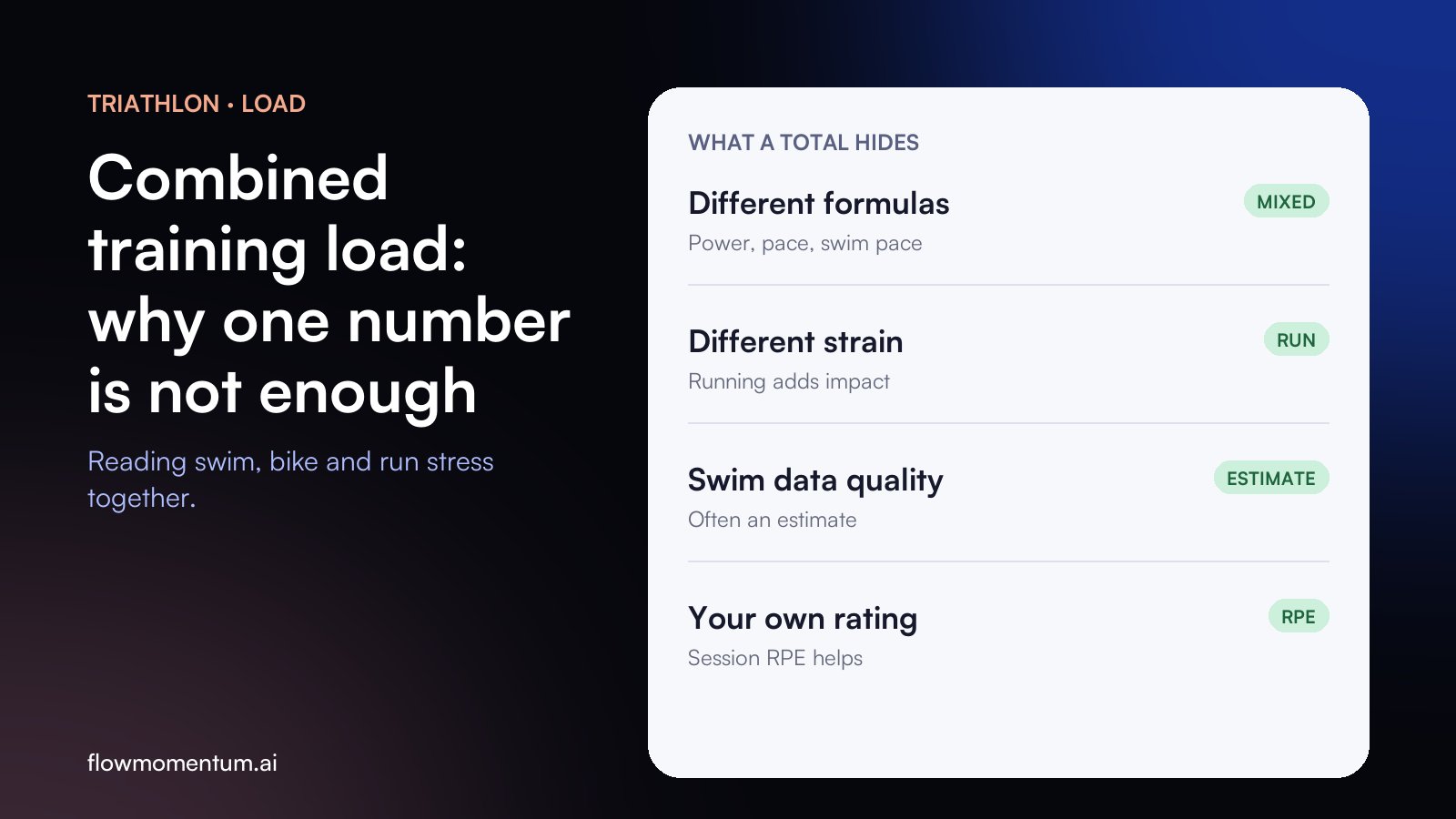
Different formulas. Bike TSS usually comes from power, run TSS from pace or heart rate, and swim TSS from pace relative to threshold pace. TrainingPeaks, for example, calculates swim TSS from pace and moving time relative to functional threshold pace (TrainingPeaks). Each is a sensible estimate. Added together, they suggest more precision than they have.
Different strain. Running involves impact; swimming and cycling do not. Running off the bike also costs more energy than running fresh: a review of the cycle-to-run transition reported an increase of 1.6% to 11.6% in running energy cost (Millet and Vleck, 2000). A week heavy in running can leave your legs more tired than the same total score built from swimming and cycling.
Different measurement quality. Power meters on the bike are precise. Swim distance and moving time from a watch are often not, especially with interrupted lengths, drills or open water. A swim score built on poor data shifts the total without anyone noticing.
The practical risk is simple: your combined form looks fresh while your running is not.
How to read combined load sensibly
- Look at each sport separately. Is run load rising faster than bike and swim? That matters more for injury risk than the total.
- Watch the ramp rate. Large week-to-week jumps in total load are a warning sign, whatever the source.
- Check how you feel. Session RPE (duration × how hard the session felt) is a validated way to track swim load. In well-trained swimmers it correlated significantly with heart-rate-based load and distance (Wallace et al., 2009).
- Count bricks as they felt. A run straight after a ride is harder than its pace suggests. If it felt hard, rate it as hard.
- Do not chase a form number before a race. Use it as context for the taper, alongside sleep, soreness and how key sessions feel.
Where Flow Momentum stands today
- Bike and run load use power, pace or heart rate, with the formulas published. Running training load is calculated from pace and is not yet linked to critical running power.
- Swim load is a fixed-intensity estimate from duration. It does not yet use your Critical Swim Speed, even if you have entered one. A hard interval set and an easy technique swim of the same length currently count the same.
- That means your combined triathlon load is most reliable for bike and run, and approximate for swimming.
Our triathlon page says the same in one line: bike and run in full, swim load as an estimate. For how to test Critical Swim Speed and what it can and cannot tell you, see Critical Swim Speed explained. For structuring a first half-distance race around work, see your first 70.3 with a full-time job.
Try this week
After every swim this week, note how hard the whole session felt on a 0–10 scale and multiply it by the minutes. Compare those numbers with your platform's swim score. Where they disagree most, your swim data is probably least reliable.
Frequently asked questions
Closing thought
One load number is a good summary and a poor decision tool. For triathletes, the useful questions are which sport is driving fatigue this week, and how much you trust the data behind each part.
Sources
- Millet GP, Vleck VE (2000). Physiological and biomechanical adaptations to the cycle to run transition in Olympic triathlon: review and practical recommendations for training. Br J Sports Med 34(5):384–390. PMC1756235
- TrainingPeaks. Calculating swimming TSS score. Accessed 24 October 2026.
- Wallace LK, Slattery KM, Coutts AJ (2009). The ecological validity and application of the session-RPE method for quantifying training loads in swimming. J Strength Cond Res 23(1):33–38. UTS repository
Get the next Note
Practical ideas on performance, recovery, AI and better work — straight to your inbox.