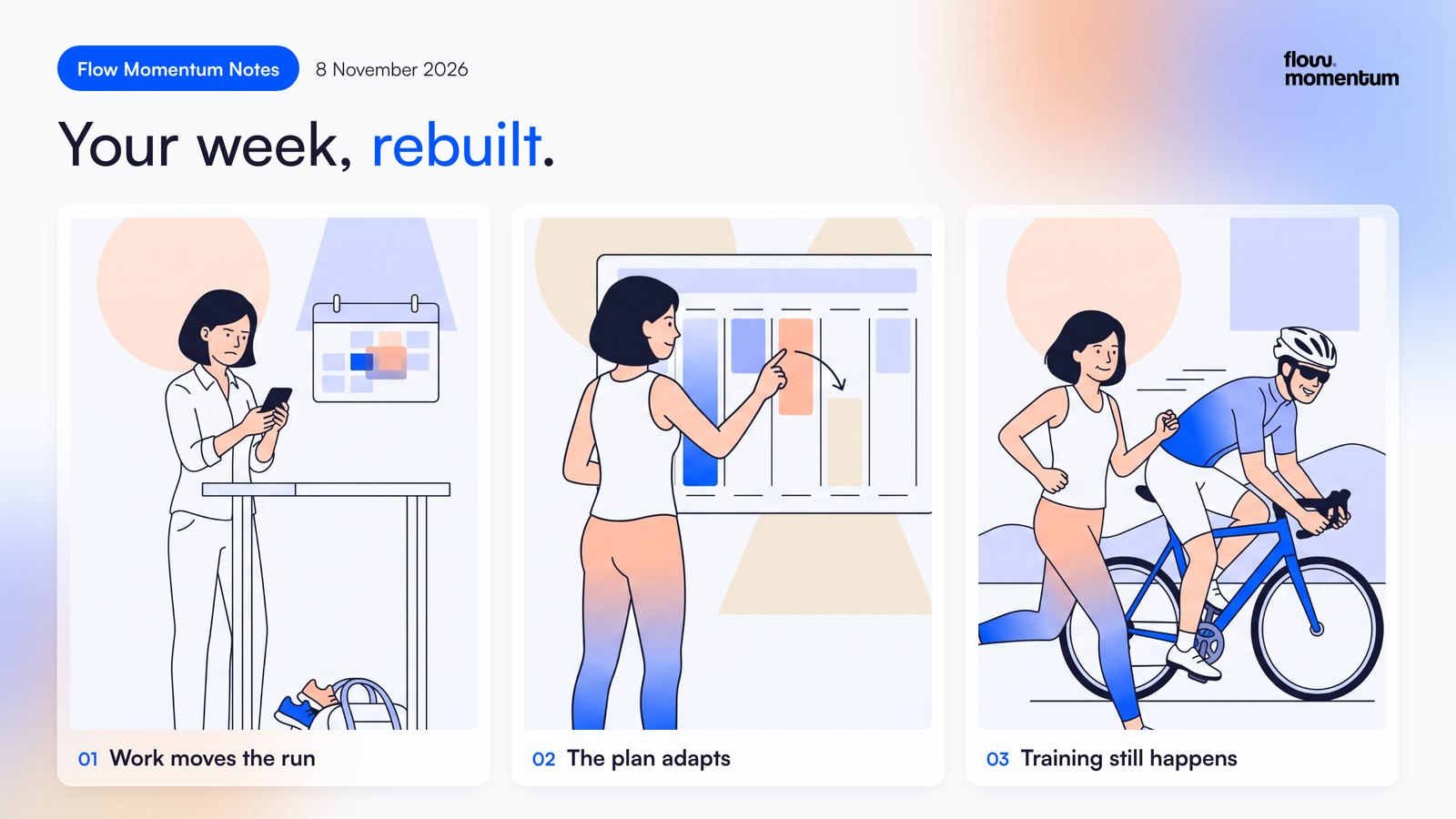
Work Moved Your Run: How to Rebuild a Training Week
Five rules for the week that did not go to plan, for runners, cyclists and triathletes with full-time jobs.
In short: When work takes a session, do not squeeze it back in on top of the rest. Decide which session mattered most, protect it, shorten easy sessions instead of skipping them, never stack two hard days and let next week absorb the change.
It is Tuesday at 7:10. You are dressed to run. Then the calendar changes: a call has moved to 7:30, and the 50 minutes you planned are gone.
Most people react in one of two ways. They write the week off, or they try to fit the missing run in later, usually on a day that already has something hard in it. Neither helps much.
A training week is not a list to complete. It is a small number of sessions that do a job, plus easy work that supports them. When work moves something, rebuild the week around that job.
Rule 1: Find the session that matters
Look at the week and ask one question: which session would I most regret losing?
For a marathon runner it is usually the long run. For a cyclist preparing for a hilly sportive it may be the one ride with climbing. For a triathlete it is often the brick session or the swim that is hardest to reschedule.
Protect that session first. Everything else is negotiable.
Rule 2: Move, do not stack
If the key session has gone, move it to the next day that is free of other hard work. Do not add it on top of another hard session.
Two hard days in a row usually means both are done at a lower quality. Keep at least one easy day or rest day between them.
Rule 3: Shorten before you skip
If time is the problem, not fatigue, a shorter session still counts. A 25-minute easy run, a 40-minute spin or a short swim keeps the routine alive.
Shorten the easy sessions first. They give the most room to adjust.
Rule 4: A busy day is part of the load
A day of meetings, travel or a late finish does not show up in your training data. It still affects how a hard session feels.
When the working day was heavy, it is reasonable to swap a hard session for an easy one and move the hard one. If you track sleep and heart rate variability, our note on when to take an easy day explains how to read those signals with care.
Rule 5: Let next week absorb it
One changed week is normal. What matters is the trend over several weeks.
If a week came out lighter than planned, do not try to recover the whole difference in the next one. Look at the next two or three weeks and spread small changes across them. If weeks keep coming out lighter, the plan is probably too ambitious for the life you have, and that is worth changing.
A worked example
Planned week for a runner with a full-time job:
| Day | Planned | What happened | Rebuilt |
|---|---|---|---|
| Tuesday | Easy run, 50 min | Early call, no run | Rest |
| Wednesday | Intervals, 45 min | Free at lunchtime | Easy run, 35 min |
| Thursday | Easy run, 40 min | Free in the evening | Intervals, 45 min |
| Friday | Rest | Rest | Rest |
| Saturday | Long run, 90 min | As planned | Long run, 90 min |
The intervals moved by a day, the easy run became shorter and the long run stayed where it was. Nothing was squeezed into a day that already had hard work in it.
How Flow Momentum helps
Flow Momentum reads the training you actually did, compares it with what was planned and suggests how the next weeks should change. The coaches in the app explain why, and you decide. If you want to know how the numbers behind that work, read how Flow Momentum calculates your numbers.
We are looking for 10 founding members who train around demanding jobs. They get 6 months free and tell us what to improve in a monthly feedback session. Read about founding access.
Related notes
Frequently asked questions
Get the next Note
Practical ideas on performance, recovery, AI and better work — straight to your inbox.